OTBI, FDI, OAC, and OAC + ADW: Picking the Right Way to Report on Oracle Fusion Data
By Konstantin Zhernevskiy, Senior Data Architect, Data Intensity
There are several native reporting options for Fusion Cloud Applications, and it can be difficult to choose the right one. OTBI (Oracle Transactional Business Intelligence) reads live transactional data. FDI (Fusion Data Intelligence) is a prebuilt analytics warehouse. OAC (Oracle Analytics Cloud) is the general analytics platform, and OAC paired with ADW (Autonomous Data Warehouse) is the fully custom path. They overlap a lot, which is exactly why the choice gets confusing. Here is a side-by-side look at where each one fits, including how the data flows, what you can customize, the AI features, and what it costs.
You may also see FAIDP (Fusion AI Data Platform) used to refer to FDI, but Oracle is now standardizing on the FDI name [9].
Oracle’s analytics platform grew out of Oracle Business Intelligence Enterprise Edition (OBIEE). OBIEE became Oracle Analytics Server (OAS) on-premises and OAC in the cloud [1]. OTBI is the OBIEE engine embedded inside Fusion Apps, riding the same Answers foundation [2].
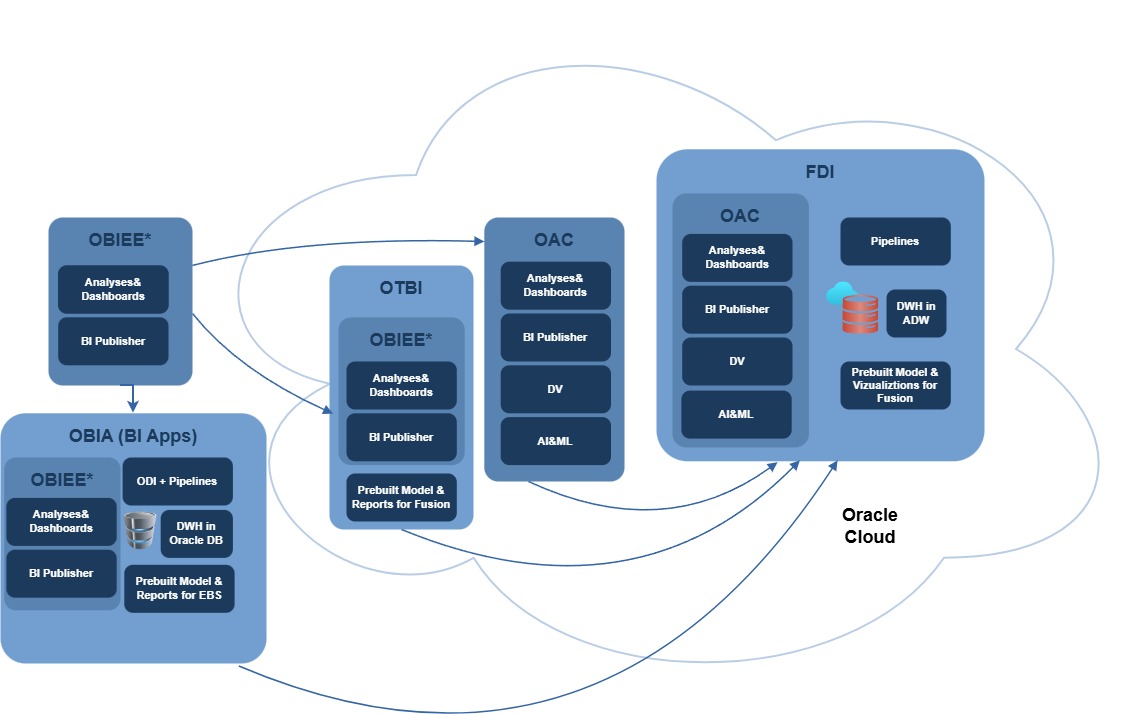
Oracle Analytics Evolution
The cleanest way to see the difference is by components:
- OBIEE* = Classic Analytics (Analyses and Dashboards) + BI Publisher (pixel-perfect reporting).
Technically, Oracle introduced DV in the later on-premises OBIEE 12c releases. However, OTBI is based on the classic OBIEE experience and does not include DV. For simplicity, this article uses “OBIEE”. - OAC = Analytics + BI Publisher + Data Visualization (DV) in the cloud + AI features.
- OTBI = the embedded OBIEE engine in Fusion, exposing Classic Analytics, BI Publisher, and prebuilt subject areas.
- FDI = ready-to-use prebuilt pipelines, data model, semantic layer, subject areas, security model, and dashboards based on OAC and ADW.
- FDI is a cloud replacement for BI Apps (OBIA - Oracle Business Intelligence Applications), the prebuilt analytics solution for on-premises EBS.
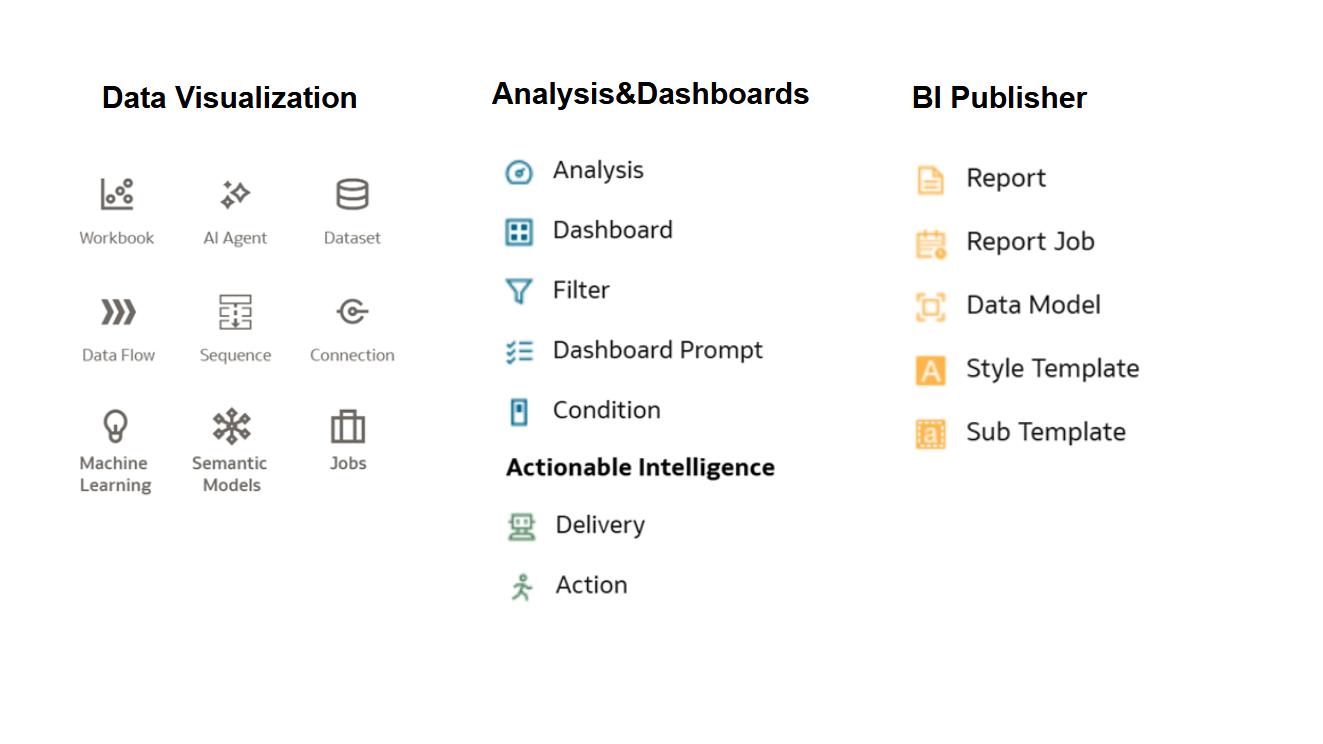
OAC objects
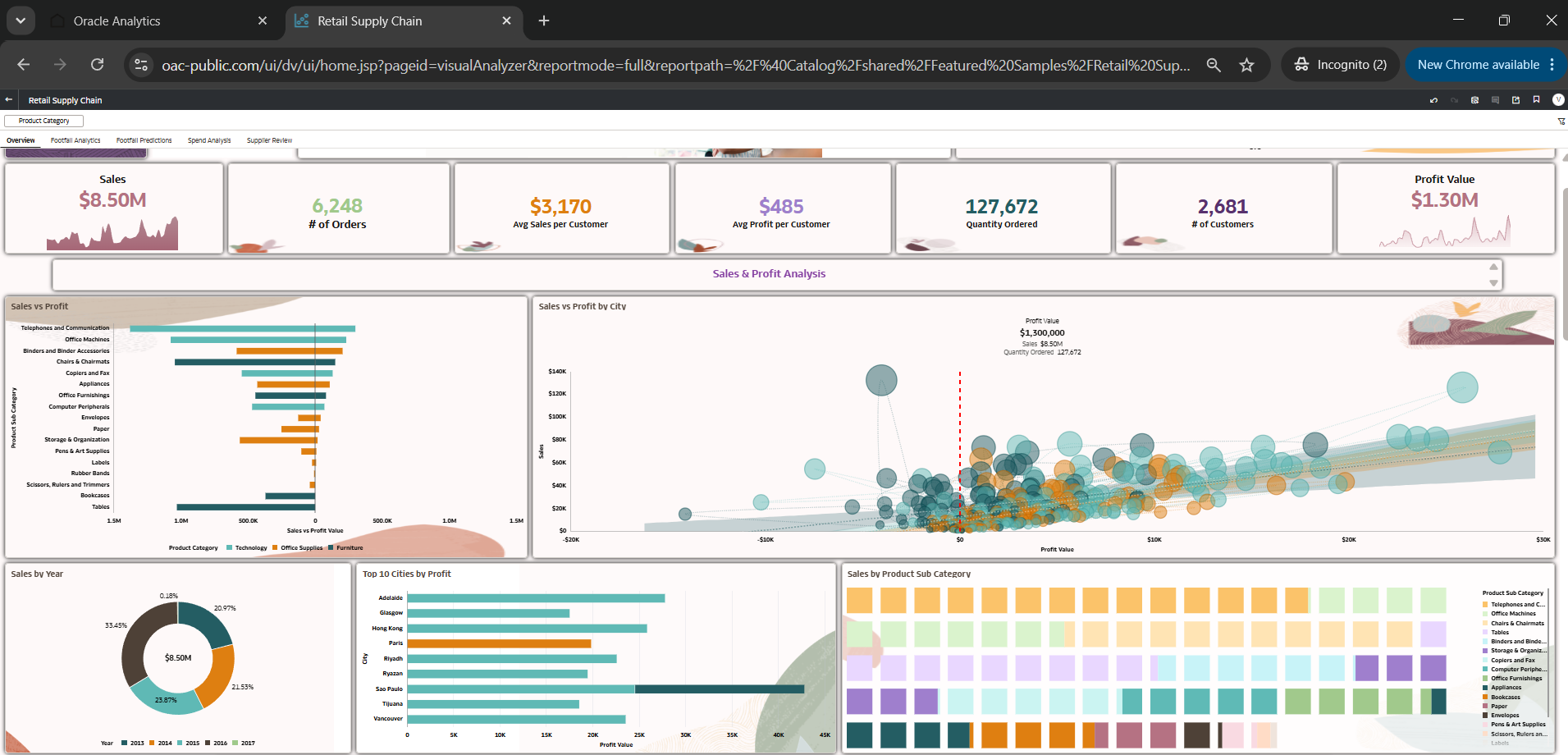
Example of an OAC Data Visualization dashboard [10]
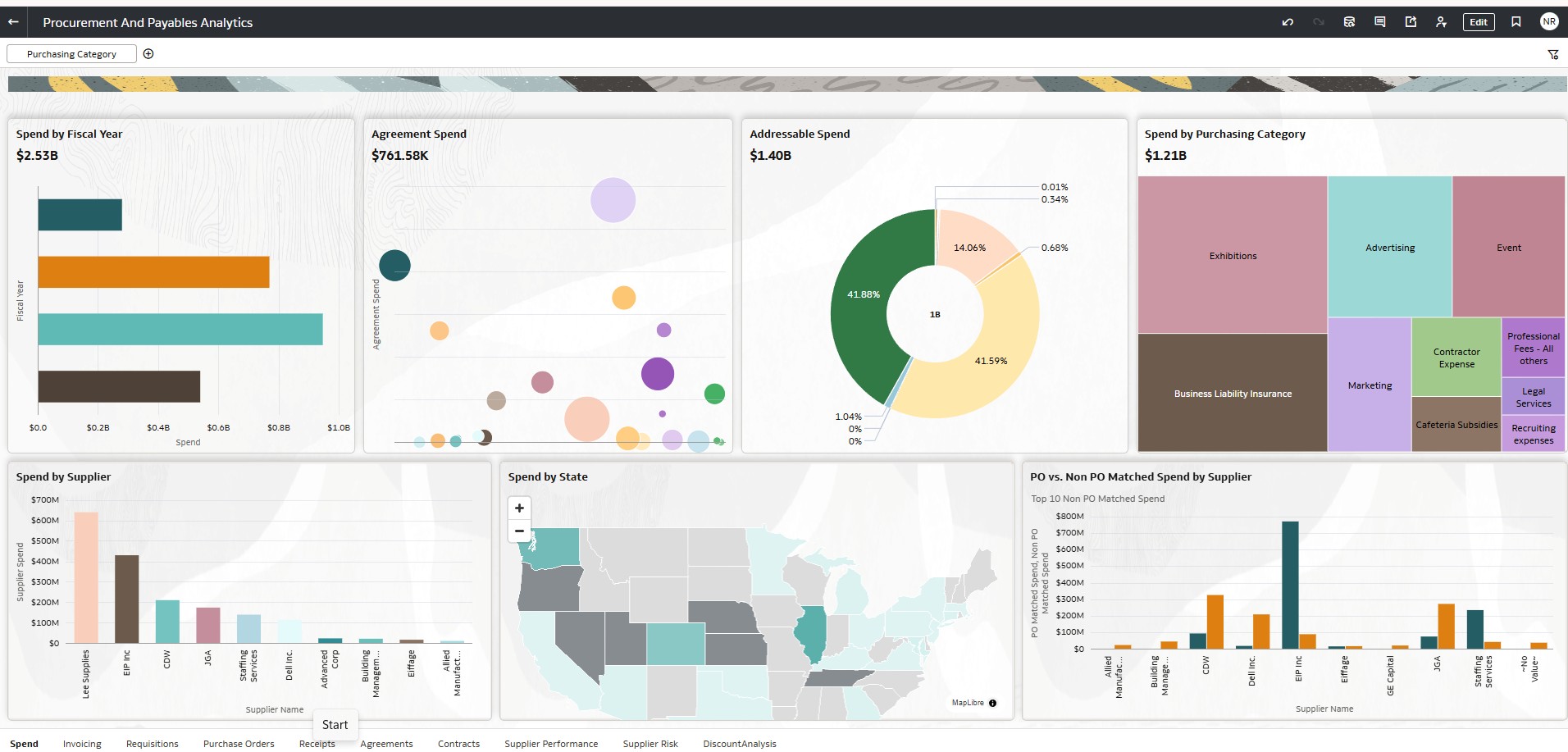
FDI dashboard example [11]
How the data reaches the user
Each option takes a different route from Fusion to the report on screen.
OTBI analyses connect to live Fusion transactional data through prebuilt subject areas, so the data is always current with no ETL layer [2]. It inherits Fusion’s security automatically, so setup is fast and users see only the rows they are allowed to see. It is included with Fusion at no extra license cost [2]. The trade-offs are real: you cannot customize the semantic model beyond flexfields, it is not built for heavy historical queries or large extracts, and because it queries the live database, large reports can affect ERP performance [2].
BI Publisher reports access data through a data model. That model can use both the semantic layer/subject areas and physical SQL queries against Fusion views and tables. Developers should be diligent with security testing. It resembles XML Publisher in the way it separates the data model from the report layout.
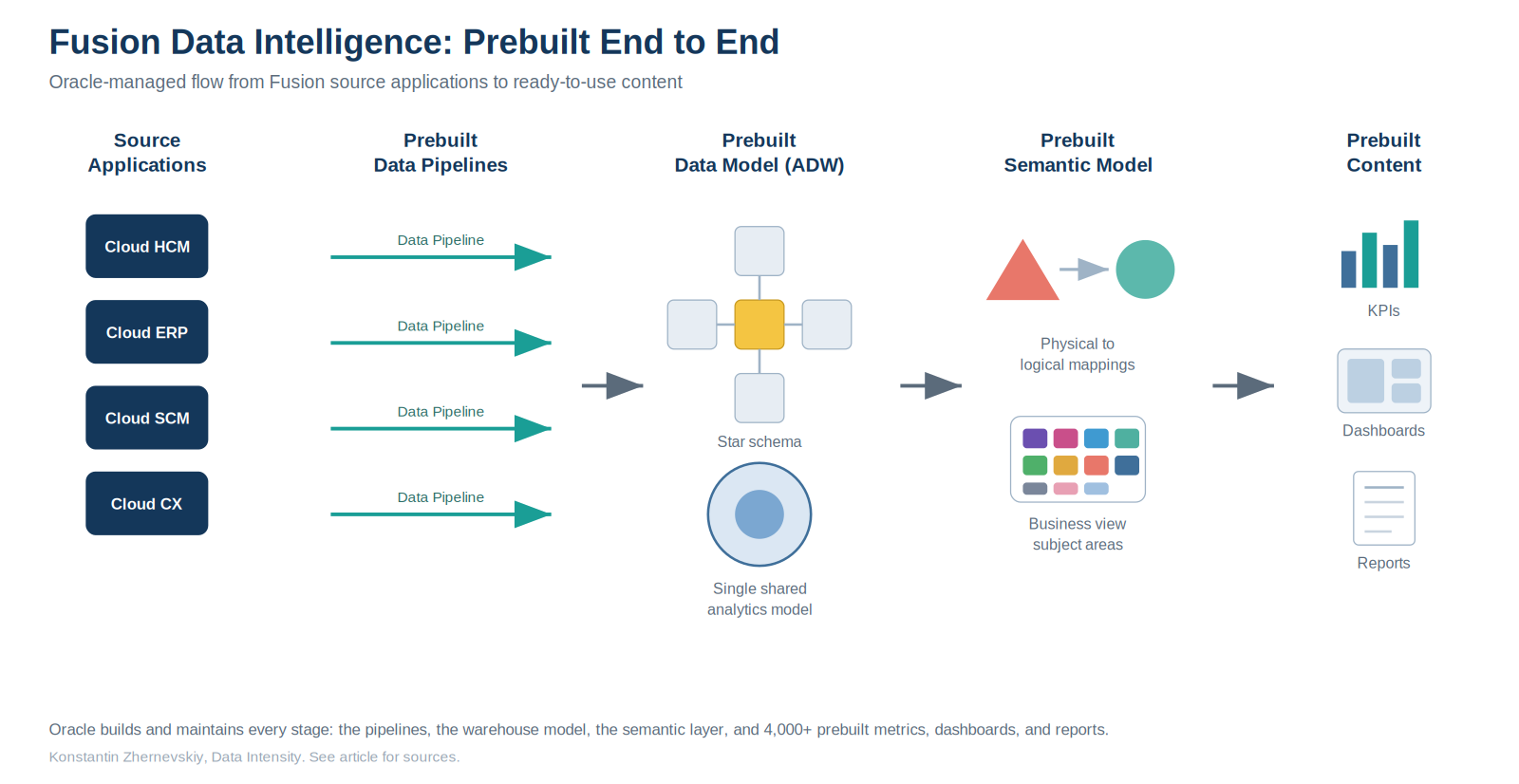
FDI is the successor to the old BI Applications for EBS. Oracle-managed pipelines extract Fusion data into a prebuilt model in Autonomous Data Warehouse, surfaced through an OAC instance [3]. Because the data is replicated and curated, FDI handles what OTBI cannot: historical trends, cross-pillar analytics, aggregation, external-data blending, and machine learning. Loading data once means FDI does not tax ERP performance [2]. It refreshes daily, as often as every 4 hours for selected areas, or on demand [4]. Its model is extensible, and the prebuilt library is large and growing: Oracle’s public Fusion Analytics Content Explorer now surfaces more than 4,000 prebuilt metrics across HR, finance, supply chain, and customer experience [5], which is why FDI deploys in weeks rather than the many months a comparable custom build takes [3]. On AI, FDI includes prebuilt ML models and the Oracle Analytics AI Assistant for natural-language exploration [3]. OTBI has no equivalent.
FDI is prebuilt end to end. Oracle owns and maintains every stage, from the source pipelines through the warehouse model and semantic layer to the finished KPIs, dashboards, and reports.
In FDI, you also have analyses and BI Publisher reports like you have in OTBI, but in addition you get Data Visualization through OAC.
OAC alone has no Fusion content. There is no prebuilt semantic model or prebuilt dashboards out of the box. You build your own semantic model and visualizations, or connect directly to Oracle Fusion Applications using the built-in Oracle Applications connector. You also build the data preparation yourself.
OAC + ADW is the fully custom path. You provision an Autonomous Data Warehouse, build your own extraction (usually via BI Cloud Connector, BICC), model the data, and visualize in OAC. This gives the most control and is the right answer when FDI’s prebuilt content does not fit or you need heavy non-Fusion integration. The cost is engineering time, since you are rebuilding what FDI gives you out of the box [1].
Side by side
| Dimension | OTBI | FDI | OAC (alone) | OAC + ADW |
|---|---|---|---|---|
| Data Visualization (DV) | Not in classic OTBI | Yes (via OAC) | Yes | Yes |
| Analytics (analyses/dashboards) | Yes, prebuilt | Yes, prebuilt | Build your own | Build your own |
| BI Publisher | Yes, prebuilt | Yes, prebuilt | Yes | Yes |
| Semantic model | Prebuilt, sealed | Prebuilt, extensible | None prebuilt | Build your own |
| Extensibility | Flexfields only | High | High | Highest |
| AI capabilities | None | AI Assistant, prebuilt ML, OAC AI, NLQ | OAC AI/ML, NLQ | OAC AI/ML, NLQ |
| Data freshness | Real-time | Daily / 4-hour / on demand | Your pipeline | Your pipeline |
| ERP performance impact | Yes, live queries | No, loads once | None directly | None directly |
| Prebuilt content | Subject areas + reports | 4,000+ metrics + dashboards | None | None |
| Cost | Included with Fusion | Separate subscription | Separate (user or OCPU) | OAC + ADW compute + storage |
Before Adding a Third-Party BI Tool, Try OAC Data Visualization
If users find the classic OTBI interface dated or are asking for tools like Power BI or Tableau, do not assume you need another analytics platform. First, give Oracle Analytics Data Visualization (DV) a try. DV provides an intuitive drag-and-drop experience for building interactive workbooks and dashboards, natural-language interaction with data, and AI-assisted insights-all while remaining within the Oracle Analytics ecosystem and leveraging the same trusted semantic model.
OAC + ADW vs. FDI: Cost of Ownership
A common question is whether building your own analytics platform with OAC and ADW costs less than subscribing to FDI.
The comparison is not straightforward. OAC and ADW have published pricing, while FDI is sold through negotiated quotes. As user counts grow, a custom OAC + ADW solution can become more cost-effective because ADW costs are driven primarily by compute rather than the number of users, whereas FDI licensing is generally per user.
However, subscription cost is only part of the equation. Three factors often outweigh the licensing difference:
-
Build and maintenance. FDI includes Oracle-managed pipelines, a prebuilt data warehouse, semantic model, and more than 4,000 metrics, dashboards, and reports. With OAC + ADW, your team must design, build, and maintain all of that.
-
Time to value. FDI can typically be deployed in weeks, while a custom OAC + ADW implementation often takes several months.
-
Fusion licensing considerations. If your ADW contains data extracted from Fusion Applications, Oracle’s employee-metric licensing may apply, potentially eliminating the expected licensing savings. Confirm the applicable licensing model with Oracle before making architectural decisions.
In general, FDI is often the most cost-effective choice for organizations focused primarily on Fusion and rapid deployment.
Organizations with large user populations, significant non-Fusion data, or an existing ADW investment may achieve a lower long-term cost with OAC + ADW, provided they have the engineering resources to build and maintain the platform.
Compare your negotiated FDI pricing with your own implementation and operating costs before deciding.
Which one, when
Keep OTBI for real-time, single-subject operational and statutory reporting. It is free, secure by default, and already in your Fusion subscription. Just keep reports modest in size to protect ERP performance.
Choose FDI when you need historical analysis, cross-pillar analytics, aggregation, external data integration, AI capabilities, or an extensible semantic model. It is also the right choice when you want to provide business users with a modern, intuitive analytics experience, natural-language interaction with data, and consistent reporting based on shared business definitions. A good indicator is when users spend significant time exporting OTBI data to Excel, combining data across modules, or building their own spreadsheets and reports in third-party tools to answer business questions.
The most important point: FDI is not a replacement for OTBI. They complement each other, and most Fusion shops should run both.
Choose OAC alone when you need a modern self-service analytics experience, lightweight data preparation and enrichment, and integration with a small number of external data sources without building a data warehouse, while staying within the Oracle Analytics ecosystem instead of adding a third-party BI tool.
Add OAC + ADW when your landscape is bigger than Fusion, with many users and many systems to bring together, and you are ready to invest the time and resources to design a custom solution, wait through a longer build, and support it afterward. This is the path for organizations that want full ownership of the warehouse and model and have the engineering capacity to build, run, and maintain the pipelines over the long term.
References
- Oracle, Oracle Analytics product pages (Oracle Analytics Server and Oracle Analytics Cloud), on the OBIEE to OAS/OAC lineage and on building your own model in OAC. https://www.oracle.com/business-analytics/ Retrieved June 2026.
- Oracle A-Team, “Choosing the Right Reporting Framework in Fusion Cloud Applications,” 2025. Covers OTBI reading live transactional data, ERP performance impact, and embedded reporting (OTBI, BI Publisher) being included with Fusion Cloud Applications. https://www.ateam-oracle.com/choosing-the-right-reporting-framework-in-fusion-cloud-applications Retrieved June 2026.
- Oracle, Fusion Data Intelligence product page (product overview, prebuilt pipelines, fast deployment, prebuilt ML models, and the Oracle Analytics AI Assistant). https://www.oracle.com/fusion-data-intelligence/ Retrieved June 2026.
- Oracle, “Administering Oracle Fusion Data Intelligence: Schedule Frequent Refreshes of Data” (daily, every-4-hour, and on-demand refresh). https://docs.oracle.com/en-us/iaas/analytics-for-applications/doc/schedule-frequent-refreshes-data.html Retrieved June 2026.
- Oracle, Fusion Analytics Content Explorer (browsable public library of prebuilt metrics, dashboards, and subject areas; more than 4,000 metrics). https://oac-public.com/ui/dv/ui/home.jsp?anonymous=true&pageid=visualAnalyzer&reportmode=full&reportpath=%2F%40Catalog%2Fshared%2FFeatured%20Samples%2FFusion%20Analytics%20Content%20Explorer Retrieved June 2026.
- Oracle, “Administering Oracle Fusion Data Intelligence: About Licensing” (employee-metric requirement when data is used with third-party tools or exported downstream). https://docs.oracle.com/en-us/iaas/analytics-for-applications/doc/licensing.html Retrieved June 2026.
- Oracle, Oracle Analytics Cloud pricing. https://www.oracle.com/business-analytics/pricing/ Retrieved June 2026.
- Oracle, Oracle Autonomous Data Warehouse (serverless) ECPU pricing and 2-ECPU minimum, plus storage; BYOL for holders of Oracle Database licenses. Oracle Cloud Price List. https://www.oracle.com/cloud/price-list/ Retrieved June 2026.
- Oracle Analytics Blog, “Move Faster from Insight to Action with AI-Powered Fusion Data Intelligence.” https://blogs.oracle.com/analytics/move-faster-from-insight-to-action-with-ai-powered-fusion-data-intelligence Retrieved June 2026.
- Oracle Analytics public sample dashboard. https://oac-public.com/ui/dv/ui/home.jsp?pageid=home Retrieved June 2026.
- Oracle demo environment. https://demo.oraclecloud.com/ Retrieved June 2026.